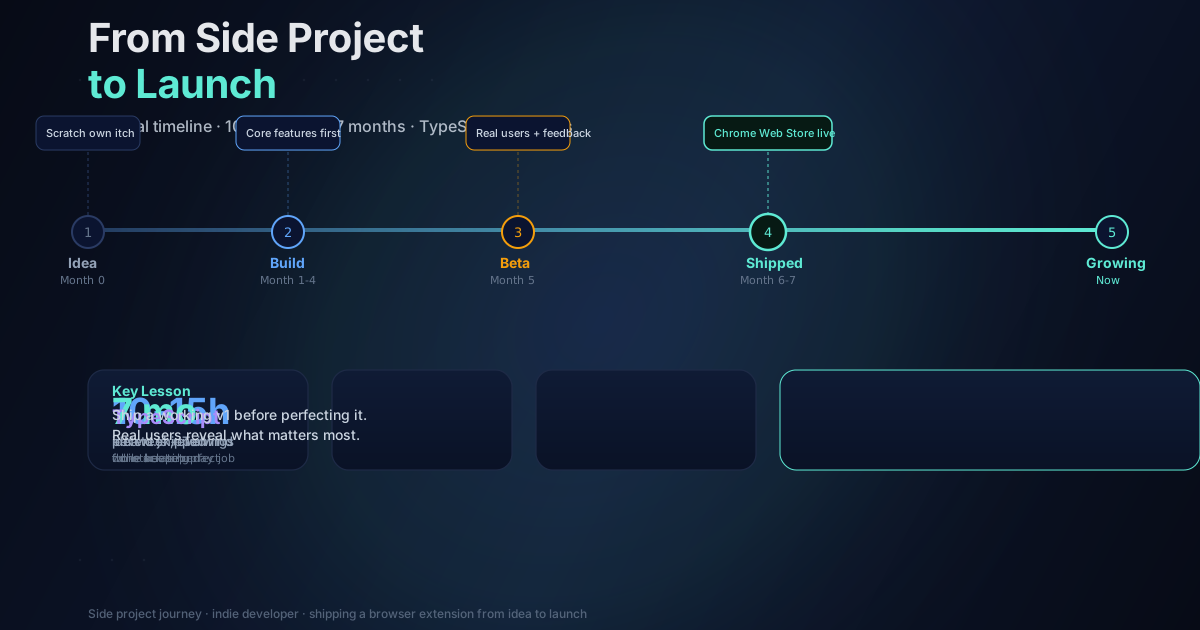
From Side Project to Launch
TraceMind started as a frustrated evening project and somehow turned into a real product. Here's how that happened while I was also doing client work during the day, and what I actually learned about building software in the gaps of another full-time job.
The Constraints That Shaped Everything
I have a full-time job. Actually several, depending on how you count. There's the main client work: complex web applications, CMS integrations, data syncing between APIs. There are smaller projects that come and go. Maintenance of things already built. The workload is steady and demanding.
TraceMind gets built in the gaps. After dinner, usually. Sometimes weekends. Occasionally during slow periods when client work is waiting on feedback. I don't have long uninterrupted stretches to focus. I have an hour here, two hours there, occasionally a rare Saturday afternoon.
This changes how you build software in ways that aren't obvious until you've tried it. You can't hold complex systems in your head across days of interruption. You come back to code you wrote three days ago and genuinely wonder what past-you was thinking. The implementation you half-started before being pulled away for two days is a different kind of problem than code you wrote in a continuous flow state.
I figured out over time that fighting these constraints doesn't work. You have to design for them.
How I Actually Make Progress
I write a lot of notes. Not formal documentation, just messy text files explaining what I'm working on and what I planned to do next. When I sit down after a few days away, I read the notes and context comes back. It's like leaving yourself a trail of breadcrumbs back to your own thinking. The notes don't have to be good. They just have to be specific enough that I can reconstruct why I was doing something.
I also build in smaller chunks than I would for a full-time project. Instead of designing a complete feature and implementing it over a week, I break everything into pieces that can each be finished in a single session. One evening might be just the database schema for a new feature. The next evening is the query function. Then the UI component. Then the integration test. Each piece is complete on its own and doesn't depend on a future session to be coherent.
This matters more than it sounds. If a session ends with something half-built, I can't ship anything and I'll spend the start of the next session figuring out where I left off. If every session ends with something that works, I can ship incrementally, and even if I can't work on TraceMind for a week, nothing is broken.
The other thing that's made a difference is ruthless prioritization. When time is scarce, you can't afford to work on things that don't matter. Every feature that goes into TraceMind has to earn its place. Does this meaningfully improve the product? Will users notice? If the answer isn't a clear yes, it waits or gets cut entirely.
I've deleted a lot of code. Features that seemed important during planning but turned out to be unnecessary when I actually used the product. Premature optimizations for scale I don't have. Clever abstractions that made the code harder to understand. The product is better for being smaller.
The Technical Choices That Saved Me
A few architectural decisions turned out to be much more important than they looked at planning time.
Building as an extension rather than a web app kept the distribution story simple. Users install once from the Chrome Web Store, and the extension is always there. No hosting infrastructure to manage, no server costs, no worrying about whether the service is up when someone tries to use it. As a one-person evenings-and-weekends operation, not having to maintain server infrastructure was a significant advantage.
Going local-first (everything in IndexedDB, model running in-browser) also turned out to simplify the architecture dramatically. I didn't have to build authentication, user accounts, data sync, or any backend API. The complexity of the system is almost entirely on the client side, in a codebase I can understand and modify in a single session without needing to mentally track server-side state.
This wasn't just a philosophical decision about privacy (though I believe strongly in the local-first approach for this use case). It was also a practical decision about what I could actually maintain alone. A full-stack system with a backend, database, and API would have been significantly more to build and maintain. The local-first constraint made the scope manageable.
Using existing libraries where possible: Mozilla Readability for content extraction (the same library Firefox uses for Reader Mode), FlexSearch for full-text indexing, Transformers.js for running the all-MiniLM-L6-v2 embedding model via WASM. I didn't invent any of the core components. I integrated them and built the product layer on top.
The places I had to build custom: the Reciprocal Rank Fusion implementation for merging vector and full-text results, the SPA navigation detection (intercepting pushState and replaceState), the SHA-256 deduplication logic, and the lz-string compression pipeline. These are the parts that required actual original work. Everything else was integration.
Energy Management Is Half the Job
Time management for a side project is obvious: guard your evenings, work on weekends when you can, protect focused blocks from interruption. The less obvious part is energy management.
Client work uses mental energy. Some evenings I sit down to work on TraceMind and nothing comes. The brain is empty. Forcing it doesn't help. I've learned to recognize those nights early and switch to something that doesn't require creative thinking: testing, writing documentation, organizing assets, responding to user feedback. Save the design and implementation work for when I actually have capacity.
I've learned to protect mornings for client work and evenings for TraceMind. Mixing them throughout the day doesn't work. Context switching between completely different codebases and problem spaces is expensive. If I start the day thinking about the extension, the whole morning is gone before I do any billable work. If I try to squeeze TraceMind between client tasks, neither gets real attention.
There were weeks when I didn't touch TraceMind at all because client deadlines consumed everything. That used to bother me more than it does now. Missing a week doesn't derail the project if you come back to it. Missing months would. A week is fine.
The Hard Part Nobody Talks About
The hardest part isn't time or energy. It's maintaining belief that the project matters.
There are weeks when nothing seems to work. When bugs appear faster than I can fix them. When I look at what other developers are shipping (with full-time teams, funding, dedicated engineering time) and feel hopelessly behind. When the effort of working evenings after already working all day seems pointless.
The thing that consistently keeps me going is using the product myself. Every time TraceMind helps me find a page I couldn't find otherwise, I remember why I'm building it. The product is genuinely useful. It solves a real problem that I have. Even if nobody else ever used it, I would still use it.
That's the test I'd apply to any side project before starting: would you use this even if it never got users? If yes, you have the motivation to sustain it through the hard weeks. If you're building it primarily because you think other people will want it, you'll run out of momentum the first time growth stalls or a feature doesn't land.
TraceMind passes that test easily. The reason I built it was a real, personal frustration, not a market opportunity I spotted. The full story behind why I built it is its own post, but the short version is: I wasted 40 minutes looking for a Stack Overflow thread I'd found earlier that day, and the anger was productive.
What the Launch Actually Looked Like
I had been using TraceMind for personal use for months before putting it on the Chrome Web Store. The gap between "this works for me" and "this is ready for strangers" was larger than I expected.
The Chrome Web Store review process took longer than anticipated. There are privacy policy requirements, extension description requirements, and screenshot requirements. Google reviews extensions for policy compliance before publishing. Getting through that process while managing client work took a few weeks of effort I hadn't fully planned for.
The initial launch was quiet. I posted to a few indie maker communities, replied to relevant threads where people asked about browser history tools, and let it find its audience organically. I didn't have a launch-day plan so much as a "get it out and see who finds it" plan.
Growth has been gradual and mostly word-of-mouth. People who find it useful tell other people who have the same problem. The Chrome Web Store listing helps with discoverability. The blog has started to generate organic search traffic as posts accumulate.
If I were doing it again, I'd spend more time before launch on the marketing infrastructure: the blog, the comparison pages, the SEO fundamentals. All of that takes time to gain traction, and starting it earlier means it's working for you by the time you launch rather than being something you're building after the fact.
What I'd Tell Someone Starting Now
A few things that actually matter, based on what actually worked:
Ship something small quickly. I waited longer than I should have to put the first version on the Chrome Web Store because I wanted more features. In hindsight, I should have shipped earlier and added features based on real user feedback. The features I thought were essential pre-launch mostly weren't.
Build something you personally need. Not something you think the market needs, but something you would use yourself every day. The daily use keeps you motivated through the hard weeks and gives you constant feedback about whether it's working.
Constrain the scope aggressively. Every feature you add is a feature you have to maintain, debug, document, and explain. The product should be as small as it can be while still solving the core problem well.
Local-first is underrated for solo projects. No backend means no infrastructure to maintain, no server bills, no authentication to build, no data breach liability. If your use case can live on the client, that's often the right choice.
Protect your motivation. It's the scarcest resource. Don't burn it on debates about architecture choices that don't really matter or premature optimization for problems you don't have yet.
TraceMind is live, it works, and real people are using it to find things they couldn't find before. That's the measure of whether it was worth the evenings. By that measure, it was.
Try TraceMind free and see if it solves the problem for you the way it does for me.
About the Author
A full-stack developer juggling client work and side projects. TraceMind is my current focus. Find me on Twitter and GitHub.